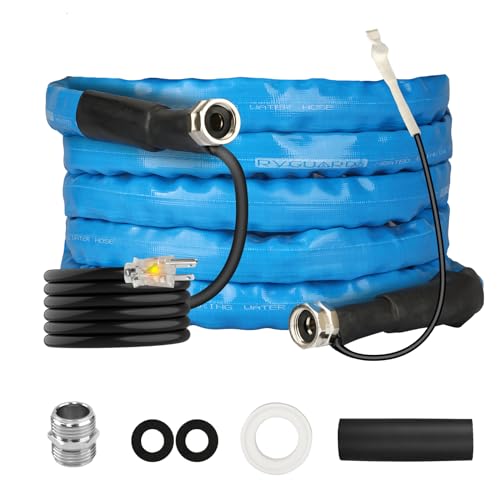
The Smart Camper's Guide: How to Truly Prevent Your RV Water Hose from Freezing
Introduction: The Quest for Convenience and Reliability
Every winter, RV owners face the same dilemma: how to have running water without the daily hassle of wrestling frozen hoses. The desire for a simple, "connected and ready to use" system is universal among campers, farmers, and anyone needing reliable water in freezing temperatures.
Consider this real-world scenario that perfectly captures the frustration:
"I purchased 2 of the 100 feet Heated Water Hose for RV to use to fill our horses water trough. If we leave it connected to the outside frost proof spigot and keep it plugged in can we keep it outside connected ready to use? Any tips and tricks are greatly appreciated as right now we are disconnecting it all bringing it inside and then taking it back outside every time we want to use it."

Here's the good news: Yes, you absolutely can leave your heated hose connected throughout winter. That's exactly what these specialized hoses are designed for. However, there's one critical insight that separates those who enjoy uninterrupted winter water from those who still face morning frustrations.
This guide will walk you through not just the basics of using an RV winter water hose, but the advanced technique that ensures complete reliability, answering both the "how" and the "why" behind preventing frozen connections for good.
Understanding Your Tool: How a Quality Heated Water Hose Actually Works
Before diving into techniques, it's helpful to understand what makes a heated water hose different from regular garden hose. This isn't marketing hype—there's actual engineering that makes winter water access possible.
At its core, a heated water hose contains a heating element (usually electrical wires) embedded along its length, controlled by a thermostat. When the temperature drops near freezing—typically around 38-42°F (3-6°C)—the thermostat activates the heating element. The hose warms just enough to keep water flowing inside it, then automatically turns off once temperatures rise above the danger zone.
When selecting a best heated water hose for RV use, look for these key features:
- Adequate wattage (more watts per foot generally means better freeze protection)
- Automatic thermostat control (no manual switching required)
- Durable, abrasion-resistant outer jacket suitable for outdoor use
- Water-safe materials that won't leach chemicals into your drinking water
Understanding this basic operation helps explain why simply plugging in the hose gives you a huge advantage over conventional hoses. The heating element does the heavy lifting of keeping water in the main hose section from freezing solid.
The Straight Answer: Yes, You Can and Should Leave It Connected
Let's directly address the central question from our reader: Can you leave a heated hose connected to a frost-proof spigot all winter?
Absolutely. In fact, that's the optimal way to use it. Here's why:
-
Frost-proof spigots are designed for this: These specialized outdoor faucets shut off the water supply inside your warm building wall, preventing freezing in the pipes behind the wall. What remains exposed is just the threaded portion and whatever hose is attached.
-
Continuous protection beats reactionary measures: Heating elements work more efficiently maintaining temperature than trying to thaw already-frozen sections. Keeping the hose powered continuously means it responds immediately to temperature drops rather than playing catch-up.
-
Reduced wear and tear: Constantly coiling, uncoiling, and moving hoses causes physical stress on connections and the hose itself. A stationary setup experiences less mechanical wear.
Basic Setup Checklist for Permanent Installation:
- Verify your outdoor electrical outlet is GFCI-protected (essential for safety with any outdoor electrical device)
- Use a weather-rated extension cord if needed, ensuring it's rated for the wattage of your heated hose
- Connect the hose directly to your frost-proof spigot
- Run the hose to your destination (RV, animal trough, etc.) with gentle curves rather than sharp bends
- Plug in the hose and verify the power indicator (if present) illuminates
- During initial setup, run water briefly to confirm flow and check for leaks
This setup alone will solve 80% of winter water problems. But for that remaining 20%—those particularly cold nights or situations with additional complications—we need to understand a subtle but critical phenomenon.
The Hidden Weakness: Why Heated Hoses Sometimes Freeze Anyway
Despite having a perfectly functional heated water hose, some users still wake up to disappointing results. The hose itself feels warm to the touch, yet no water flows when they turn on the faucet. What gives?
The culprit isn't the hose itself, but a physics phenomenon known as thermal bridging or cold sink effect.
Here's what happens in simple terms:
Metal components—your faucet, water pressure regulator, inline filters, and RV water inlet—conduct heat away from the ends of the heated hose much faster than the hose can replace it. Even though warm water flows through these metal parts during use, when water sits stagnant overnight, these "heat sinks" pull warmth away so effectively that small amounts of trapped water can freeze solid, creating ice plugs.
Think of it this way: You're wearing an excellent heated jacket, but you've left a zipper made of ice-cold metal completely open. Your torso might stay warm, but you'll definitely feel that cold spot.
In practical terms, the most vulnerable points are:
- The faucet assembly (especially the metal threads and any attached pressure regulator)
- Inline filter housings (which often hold several ounces of stationary water)
- The RV water inlet connection (exposed metal facing the elements)
- Any brass or metal connectors between hose segments

These components typically lack integrated heating elements because they connect to various devices, so they rely entirely on heat conducted from the adjacent heated hose. On bitterly cold, windy nights, that conducted heat simply isn't enough.
The Professional Solution: Implementing "Connection Point Insulation"
Now for the "tips and tricks" our reader requested—the practical solution to the thermal bridging problem.
The strategy is straightforward: Provide supplemental insulation specifically at the metal connection points. This doesn't require buying specialized equipment; common household or hardware store items work perfectly.
Three Critical Points to Insulate:
- The Source Assembly: Wrap your frost-proof faucet, plus any attached pressure regulator or preliminary filter.
- The Destination Inlet: Insulate your RV's water intake connection, including the first few inches of the hose attached to it.
- Intermediate Components: Don't forget any metal Y-splitters, quick-connects, or secondary filters along the hose run.
Practical Implementation Methods:
Budget-Friendly Approach (Works Remarkably Well):
- Pipe insulation foam: Available at any hardware store, this slit foam tubing slides right over standard hose connections. For larger assemblies like pressure regulators, use the next size up and secure with duct tape.
- Homemade wraps: Old towels, blankets, or even bubble wrap create effective insulation when wrapped snugly and secured with bungee cords or zip ties.
- Pool noodle hack: Slice a foam pool noodle lengthwise and fit it around connection points, securing with waterproof tape.
Professional-Grade Solutions:
- Commercial faucet covers: These insulated boxes designed for outdoor faucets work perfectly for protecting the entire faucet-regulator assembly.
- Custom foam boxes: For permanent installations, craft insulated enclosures from foam board secured in a plastic storage bin.
- Heat tape supplemental option: In extreme climates (consistently below 0°F/-18°C), adding a short section of thermostatically controlled heat tape at vulnerable connections provides bulletproof protection.
The Golden Rule of Winter Hose Management: Insulate the metal, not just the hose. Your heated hose already protects the water inside it. Your additional task is slowing heat loss at the inevitable weak points—the places where metal meets cold air.
Complete Winter Water System Checklist
Follow this actionable list to ensure your system performs flawlessly all season:
- Initial Inspection: Examine your entire RV winter water hose for cuts, abrasions, or damaged connectors before the deep freeze arrives.
- Proper Connection: Securely attach hose from frost-proof spigot to your RV or water trough, avoiding kinks or sharp bends that restrict flow.
- Power Verification: Plug into a GFCI-protected outlet. Confirm power indicator lights (if equipped) show proper operation.
- Critical Insulation Step: Install insulation at ALL metal connection points (faucet, regulator, RV inlet).
- Flow Verification: Turn on water briefly to confirm unrestricted flow through the entire system.
- Morning After Check: Following the first cold night, check system performance before relying on it. Feel hose temperature and verify water flow.
- Ongoing Monitoring: Periodically inspect insulation for moisture accumulation or displacement, especially after heavy snow or wind.
For those in borderline freezing conditions, consider implementing a constant slight drip during coldest periods. Moving water freezes at lower temperatures than stagnant water, providing additional insurance.
Conclusion: Embracing True Winter Water Independence
The journey from hauling hoses daily to enjoying reliable winter water boils down to understanding one principle: complete system thinking.
A quality heated water hose solves the majority of the problem by protecting the water within its length. Addressing thermal bridging at connection points solves the remainder. Together, they create a solution more robust than either approach alone.
Returning to our reader's situation with the horse trough: Yes, those 100-foot heated hoses can absolutely remain connected to the frost-proof spigot all winter. By adding simple insulation at the faucet connection and where the hose attaches to the trough filler, they'll eliminate the daily hauling ritual entirely. The system becomes truly "connected and ready to use"—even during sudden cold snaps.
This approach transcends specific brands or models. Whether you're researching the best heated water hose for RV use or optimizing a setup you already own, the principles remain the same. Understand your equipment's capabilities, identify its limitations in your specific environment, and implement targeted solutions that address physics, not just symptoms.
Winter doesn't have to mean a constant battle with frozen water systems. With proper understanding and these practical techniques, you can enjoy reliable running water regardless of what the thermometer says—transforming winter watering from a chore into a non-issue.